Introduction: The “Digital First” Shift in Jharkhand
For decades, the path to a successful media business in Jharkhand was paved with newsprint. If you owned a printing press in Kokar or Tupudana, you were part of the establishment. But as we move into 2026, the landscape has shifted underneath our feet. The audience has moved from the morning hawker to the notification bar on their smartphones.
Recognizing this shift, the Information & Public Relations Department (IPRD), Government of Jharkhand, has increasingly focused its budget on Digital Media. Whether it is the promotion of the Maiya Samman Yojana, awareness about monsoon diseases, or tender notices for road construction, the government needs web portals to reach the youth.
For a news portal owner in Ranchi, Jamshedpur, or Dhanbad, getting “Empanelled” (registered) with the IPRD is the holy grail. It transforms your website from a passion project into a sustainable business entity. It opens the door to government advertisements, which offer a level of payment security that private local ads often lack.
However, the “Wild West” era of digital media is over. The government is no longer handing out ads to every blog with a domain name. The scrutiny is tighter, the traffic requirements are higher, and the documentation is rigorous.
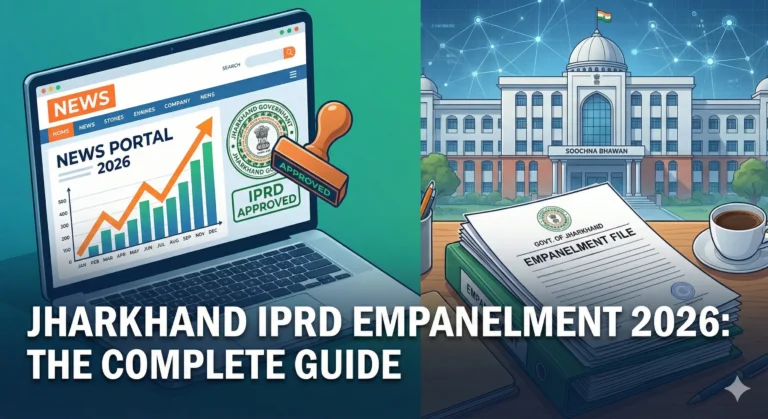
This guide is your roadmap. We will decode the entire process of getting your news portal empanelled with the Jharkhand Government for the 2026 cycle.
Part 1: Why Empanelment Matters (Beyond the Money)
Before we get into the “How,” let’s briefly look at the “Why.” Why should you go through this bureaucratic marathon?
-
Revenue Stability: Google AdSense is fickle. One algorithm update can tank your earnings. Government ads, usually released on a fixed Rate Card (often aligned with DAVP rates), provide a predictable income stream.
-
Credibility (The “Blue Tick” Effect): Being an “IPRD Empanelled Media House” is a badge of honor. It tells your readers—and private advertisers—that your site has passed the government’s technical scrutiny. It separates you from the fake news factories.
-
Access: Empanelled media houses often get priority treatment for Press Passes, entry to the Secretariat (Project Bhawan), and invitations to official government functions.
Part 2: The Eligibility Criteria (The 2026 Benchmark)
In 2026, the barrier to entry has raised. While the specific numbers may see minor tweaks in the official notification, here are the standard benchmarks you must be ready to meet.
1. Domain Age and Continuity
You cannot register a domain today and apply for ads tomorrow.
-
The Rule: Your website usually needs to be operational for a minimum of 1 to 3 years.
-
The Proof: You will need to submit your Domain Registration Certificate (WhoIs record) showing the creation date.
-
Continuity: The site must have been active continuously. If your site was down for 3 months because you forgot to renew the hosting, that gap can disqualify you.
2. Traffic Requirements (The Big Hurdle)
The government categorizes websites (typically Category A, B, and C) based on traffic. This determines your ad rate.
-
Metric Matters: They look at Unique Monthly Users (UMU) and Page Views.
-
The Benchmark:
-
Category A (State Level): Expect a requirement of 5 Lakh+ Unique Visitors per month.
-
Category B: Usually around 1 Lakh – 2.5 Lakh Unique Visitors.
-
Category C: 25,000 – 50,000 Unique Visitors.
-
-
Geography: A significant chunk of this traffic (usually >60%) must originate from India, and specifically Jharkhand. If your traffic is coming from Russia or China (bot farms), your application will be rejected immediately.
3. Content Ratios
You cannot be an “Aggregator” who just auto-feeds news from other sites.
-
Originality: Your portal must publish original news content. The IPRD technical committee checks if your reports are copy-pasted from Prabhat Khabar or PTI.
-
Update Frequency: You need to show that the site is updated daily with fresh news. A site that updates once a week is considered a “Blog,” not a “News Portal.”
Part 3: The Ultimate Document Checklist
This is where most applicants fail. They wait for the notification to release (which usually gives only 15-20 days to apply) and then scramble for documents. Start collecting these now.
A. Corporate/Business Documents
-
GST Registration Certificate: Mandatory. You cannot raise a government bill without GST.
-
Udyam Registration (MSME): Since most portals are small businesses, this is crucial proof of your entity.
-
Trade License / Professional Tax: Issued by the Ranchi Municipal Corporation (or your local civic body). This proves you have a physical office in the state.
-
PAN Card: In the name of the company/proprietorship.
-
Bank Mandate Form: A cancelled cheque and a document verified by your bank manager to enable NEFT/RTGS payments.
B. Technical Documents
-
Domain Ownership: A printout from your domain registrar (GoDaddy/BigRock) showing you or your company as the registrant.
-
Server Logs / Analytics Report: This is the most critical document. You will need to download the last 6 to 12 months of traffic reports from Google Analytics.
-
Pro-Tip: Some years, IPRD asks for this to be certified by a Chartered Accountant (CA) or a third-party auditor. Check the specific notice.
-
-
Third-Party Traffic Verification: If you are listed on Comscore or similar ranking sites, attach that proof.
C. Editorial Documents
-
Editor’s Affidavit: A notarized affidavit on stamp paper declaring:
-
There are no criminal cases pending against the Editor.
-
The content does not violate the Press Council of India norms.
-
The traffic data submitted is authentic.
-
-
Staff List: A list of your reporters, editors, and technical staff, often with their PF/ESI details (if applicable) to prove they are real employees.
-
Rate Card: Your commercial advertisement rates.
Part 4: The Application Process (Step-by-Step)
The process is a hybrid of digital and physical submissions. Here is how it usually flows at the Soochna Bhawan.
Step 1: The Online Registration
-
Navigate to the official IPRD Jharkhand website (
prdjharkhand.inor the specific e-Samvad portal). -
Look for the “Empanelment of Web Media” link.
-
Create a vendor profile. You will need to upload scanned copies of all the documents mentioned above.
-
Technical Tip: Compress your PDFs. Government portals often have a 2MB or 5MB limit per file.
Step 2: The Physical File (The “Hard Copy”)
-
Never assume the online submission is enough.
-
Purchase a high-quality file folder.
-
Create an Index Page at the front.
-
Sequence:
-
Cover Letter addressed to the Director, IPRD.
-
Printout of the Online Application Form.
-
Affidavits (Originals).
-
Business Docs (GST, PAN, MSME).
-
Traffic Reports.
-
Editorial Content Samples (Printouts of your best 5 stories).
-
-
Spiral Binding: It is highly recommended to spiral bind the documents so papers don’t get lost.
Step 3: Submission & Receipt
-
Go to the Soochna Bhawan (near Governor House/Audrey House) in Ranchi.
-
Submit the file at the designated counter.
-
The Golden Rule: Get a “Receiving” (a stamp and signature on a photocopy of your cover letter). Do not leave without this. This is your only proof that you applied before the deadline.
Part 5: The “Technical Committee” Scrutiny
Once the deadline passes, the silence begins. This is when the Technical Committee goes to work. This committee usually comprises senior IPRD officials, IT experts (often from JAP-IT or NIC), and sometimes senior journalist representatives.
What are they looking for?
-
The “Fake Traffic” Spot: They know what bought traffic looks like. If your Google Analytics shows a 90% bounce rate and an average session duration of 2 seconds, they know it’s bot traffic. You will be rejected.
-
The “Pop-Up” Nightmare: If your website is so full of betting ads (1xBet, etc.) and annoying pop-ups that the news is unreadable, you will be marked down for “Poor User Experience.”
-
Server Speed: If your site takes 20 seconds to load during their inspection, they might deem it technically incompetent.
Part 6: Life After Empanelment (Staying on the List)
Congratulations! You received the official letter. Your portal is Category B. Now what?
1. The Release Order (RO)
You don’t just get money automatically. You will receive a Release Order (RO) via email or the portal for specific campaigns (e.g., “Republic Day Greetings” or “Jharkhand Sthapana Diwas”).
-
You must display the ad for the specified duration (e.g., 7 days).
-
Screenshot Everything: Take a screenshot of the ad running on your homepage every single day.
2. The Billing Cycle
-
Submit your bill (Invoice) in triplicate.
-
Attach the Release Order (RO) copy.
-
Attach the Screenshots.
-
Attach a “Third Party Verification Report” (if required) proving the traffic during those specific days.
-
Submit this to the Advertisement Section at Soochna Bhawan.
3. Avoiding “De-Empanelment”
It is easier to get kicked off the list than to get on it.
-
Don’t publish hate speech. A single communal article can lead to an FIR and immediate removal from the empanelment list.
-
Maintain Traffic. If you got in with 50k visitors but drop to 5k next month, you can be downgraded or removed during the annual review.
Part 7: Future-Proofing for 2026 and Beyond
As we look toward 2026, the empanelment norms are likely to include new tech requirements. Here is how to stay ahead of the curve:
-
Mobile Responsiveness: 90% of news is consumed on mobile. If your site isn’t mobile-optimized (AMP or responsive design), IPRD may reject it.
-
DPDP Act Compliance: With the new Digital Personal Data Protection rules, ensure your website has a clear Privacy Policy and Cookie Consent banner. The government cannot officially partner with sites that violate central laws.
-
Fact-Checking Mechanism: Having a designated “Grievance Officer” listed on your site (a requirement under IT Rules 2021) will be a huge plus point for your credibility.
Conclusion
Getting empanelled with the Jharkhand Government is a rigorous process, and rightly so. It is a partnership where the state funds you to communicate with the public.
If you are serious about this, do not treat your news portal as a hobby. Treat it like a startup. Audit your traffic, clean up your website’s design, organize your paperwork, and report the truth.
The 2026 cycle will be competitive. The portals that survive will be the ones that combine journalistic integrity with technical discipline.