Introduction: The Power (and Limits) of the “Press Card”
In the bustling world of journalism, the “Press Card” is often viewed as a golden ticket. Whether you are a crime reporter chasing a lead in Upper Bazar or a political correspondent trying to enter the Project Building in Dhurwa, that piece of plastic around your neck is your primary identity.
However, there is a massive gap between what many journalists think their card entitles them to and what the law actually grants. Does a press card mean you don’t have to pay toll tax on the Ranchi-Jamshedpur highway? Does it guarantee you a seat on the Vande Bharat Express at half price? Can you park your bike anywhere in the city without a fine?
In Jharkhand, as in the rest of India, the privileges of a journalist depend entirely on who issued your card. A card from a local weekly newspaper does not carry the same weight as an accreditation from the Information & Public Relations Department (IPRD), Jharkhand.
This guide breaks down the legal rights, welfare schemes, and practical privileges available to journalists in our state, while also debunking some dangerous myths.
1. The Three Types of “Press Cards”
Before discussing rights, we must distinguish between the three types of IDs, as your privileges are directly tied to them.
A. The Media House ID
-
Issued By: Your employer (e.g., Prabhat Khabar, Dainik Bhaskar, News11, or a web portal).
-
Validity: Valid only as proof of employment.
-
Privileges: It identifies you as a journalist to the public and police. It grants no official government benefits.
B. The Press Club ID (e.g., Ranchi Press Club)
-
Issued By: A registered body of journalists like the Ranchi Press Club.
-
Validity: Social and professional networking.
-
Privileges:
-
Access to Press Club facilities (gym, canteen, conference halls).
-
Voting rights in club elections.
-
Networking and professional support from the community.
-
Note: While respected by local authorities, it is not a government document for official exemptions.
-
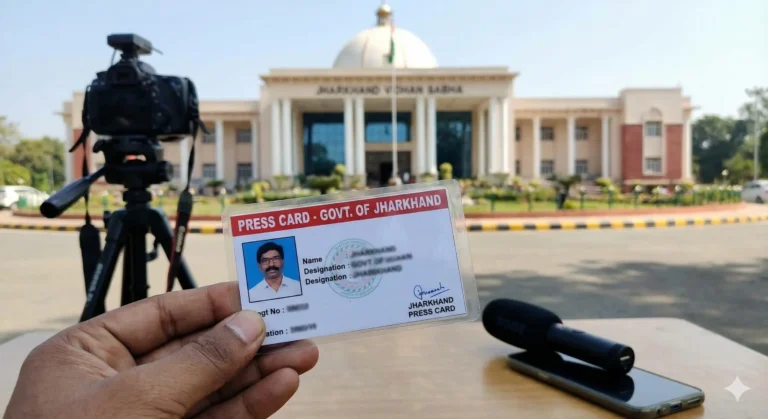
C. Government Accreditation (The “Yellow/Pink Card”)
-
Issued By: Information & Public Relations Department (IPRD), Government of Jharkhand, or the Press Information Bureau (PIB) at the center.
-
Validity: Official recognition by the State/Central Government.
-
Privileges: This is the “Real Deal.” It opens doors to the Secretariat, Assembly sessions, Health Schemes, and Pension benefits.
2. Myth vs. Reality: Transport Privileges
This is the most confused area for journalists in 2025. Let’s set the record straight regarding trains and tolls.
The Railway Concession: A Post-COVID Casualty
The Myth: “Journalists get 50% off on all train tickets.” The Reality: As of late 2025, this is FALSE.
Before the 2020 COVID-19 pandemic, the Indian Railways offered a 50% concession on the base fare to government-accredited journalists for unlimited travel.
-
Current Status: The Ministry of Railways suspended this concession in March 2020 and has not restored it yet, despite repeated demands from journalist unions and questions raised in the Rajya Sabha.
-
What this means for you: If you are booking a ticket from Ranchi to New Delhi, you pay the full fare, regardless of whether you have a PIB card or State Accreditation. Do not argue with the TTE regarding this; the concession code simply does not exist in the system anymore.
Toll Tax Exemption: The “Jugaad” vs. The Rule
The Myth: “Press cars are exempt from toll tax.” The Reality: Legally, NO.
According to the National Highways Fee Rules, 2008 (and subsequent amendments), the list of exempted vehicles includes the President, Prime Minister, MPs, MLAs, Judges, Fire Brigades, and Ambulances. “Journalists” are NOT on this list.
-
The “Jugaad”: In the past, showing a press card at a manual toll booth often worked as a “courtesy.” The toll operator would wave you through to avoid an argument.
-
The FASTag Era: With automated FASTag lanes, this courtesy is disappearing. If you enter a FASTag lane, money will be deducted. There is no “Journalist Class” FASTag that gives you zero-balance travel.
-
State Highways: While some local toll plazas on state roads might still be lenient if you show a Press Club ID, you have no legal right to demand free passage. If a toll manager insists you pay, refusing to do so can lead to a legal dispute you will likely lose.
3. Jharkhand State Government Welfare Schemes
While transport perks have reduced, the Jharkhand Government has introduced significant welfare schemes for journalists. These are accessible primarily to Accredited Journalists.
A. Jharkhand Rajya Patrakar Swasth Bima Yojna (Health Insurance)
This is one of the most vital safety nets for reporters in the state.
-
Coverage: Cashless medical insurance up to ₹5 Lakh per year.
-
Beneficiaries: Covers the journalist, spouse, and two dependent children.
-
Eligibility:
-
Must be an Accredited Journalist with the Jharkhand Government.
-
Non-accredited journalists can sometimes apply if recommended by a committee, but accreditation makes it automatic.
-
-
Premium: The government pays roughly 80% of the premium; the journalist pays only 20% (usually a nominal annual amount).
B. Jharkhand Patrakar Samman Pension Yojna
For senior journalists who have dedicated their lives to the profession, the state offers a pension scheme.
-
Pension Amount: ₹7,500 per month.
-
Eligibility:
-
Must be a resident of Jharkhand.
-
Must have completed 20 years of continuous service in journalism.
-
Must be at least 60 years old (retirement age).
-
-
The Catch: You must have valid proof of your 20-year career (PF slips, appointment letters, or regular accreditation cards). This is why renewing your IPRD card every year is crucial, even if you don’t use it for the Secretariat.
4. Access to Government Buildings & Information
Entry to the Secretariat (Project Bhawan / Nepal House)
Security at the Jharkhand Secretariat is tight.
-
With Accreditation: You are issued a permanent pass (or a yearly pass) that allows walk-in entry to the media center and public relations offices.
-
Without Accreditation: You are treated as a general visitor. You need to apply for a daily gate pass, surrender your ID at the gate, and often need an officer inside to “call” the reception to authorize your entry.
Covering the Vidhan Sabha (Assembly)
The Jharkhand Vidhan Sabha session is a high-security event.
-
Press Gallery Pass: Only issued to Accredited Journalists or reporters recommended officially by the Editor of a registered newspaper.
-
The “Lobby” Access: Senior accredited journalists are often allowed into the Central Hall or Lobby to interact with MLAs off-the-record. A standard Press Club ID will not get you past the outer perimeter of the Assembly during a session.
5. Legal Rights: Police and Public Interaction
When you are on the ground reporting—whether it’s a riot, a protest at Morabadi Ground, or a crime scene—knowing your rights prevents harassment.
A. The Right to Record in Public
-
The Rule: You have the absolute right to photograph or record video in any public place.
-
Police Interaction: A police officer cannot snatch your camera or mobile phone. They cannot force you to delete photos. Seizing a journalist’s equipment requires a court order or a specific seizure memo under the CrPC.
-
Exception: You cannot record in “Prohibited Areas” (like Defence establishments, airport tarmacs, or inside a courtroom) without specific permission.
B. Protection of Sources
-
The Principle: While India does not have a specific “Shield Law,” courts generally respect a journalist’s right to protect their sources.
-
The Law: However, if a court of law orders you to reveal a source during a criminal investigation, refusing can technically lead to contempt of court. But in day-to-day interactions, a police officer cannot bully you into revealing who gave you a document or a tip-off.
C. No “Special Immunity”
It is vital to remember that a Press Card is not an immunity shield.
-
Traffic Laws: You must wear a helmet. You must follow traffic signals. A Press sticker on your bike does not legally exempt you from challans.
-
Criminal Law: A journalist can be arrested just like any other citizen for crimes (defamation, trespassing, etc.). The Supreme Court has mandated that police should not arrest journalists for simply doing their duty, but “obstructing a public servant” is a common charge used against aggressive reporters.
6. How to Apply for Accreditation in Jharkhand
Since accreditation is the key to most benefits, here is a quick checklist for applying via the IPRD website (prdjharkhand.in):
-
Experience: Minimum 5 years of full-time journalism (for State Level) or fewer for District Level.
-
Documents Needed:
-
Appointment letter from your Editor.
-
Salary slips (or bank statement showing salary credit) for the last 12 months.
-
Clippings of your byline articles (for print) or links to video reports (for electronic).
-
Police Verification Character Certificate.
-
-
Process: The State Press Accreditation Committee meets periodically to review applications. Once approved, the card is valid for one year and must be renewed.
Conclusion: Value the Card, Respect the Rules
For a member of the Ranchi Press Club, the Press Card is a badge of honor. It signifies that you are a watchdog of society. While the “VIP culture” perks like toll exemptions and railway discounts have faded away, the core value of the card remains: Access.
It gives you the access to ask questions that others cannot. It gives you the standing to enter offices where decisions are made. And with the state’s health and pension schemes, it offers a layer of security for your family.
Actionable Advice: If you have been working for over 5 years and still rely only on your Media House ID, make it your priority this year to apply for the Government Accreditation. That yellow card is your true safety net.
Disclaimer: This blog is for informational purposes only. Rules regarding government schemes are subject to change. Please visit the official IPRD Jharkhand website for the latest notifications.